



Prostate cancer cells demonstrate unique metabolism and substrate adaptability acutely after androgen deprivation therapy - PubMed
Source : https://pubmed.ncbi.nlm.nih.gov/35980831/
doi: 10.1002/pros.24428. Online ahead of print. 1 Department of Urology, School of Medicine and Public Health, University of Wisconsin, Madison, Wisconsin, USA. 2 Department of Biomedical Engineering, University of Wisconsin,...
Conclusions: Hormone-sensitive PC cells displayed altered metabolic profiles early after ADT including an overall depression in energy metabolism, induction of a quiescent/senescent phenotype, and sensitivity to selected metabolic inhibitors. Glycolytic blocking agents (e.g., 2-DG) as a sequential treatment after ADT may be promising.

Lineage plasticity in prostate cancer depends on JAK/STAT inflammatory signaling - PubMed
Source : https://pubmed.ncbi.nlm.nih.gov/35981096/
Drug resistance in cancer is often linked to changes in tumor cell state or lineage, but the molecular mechanisms driving this plasticity remain unclear. Using murine organoid and genetically engineered...
Relevance/Conclusion: Drug resistance in cancer is often linked to changes in tumor cell state or lineage, but the molecular mechanisms driving this plasticity remain unclear. Using murine organoid and genetically engineered mouse models, we investigated the causes of lineage plasticity in prostate cancer and its relationship to antiandrogen...

Are higher pre-diagnosis follicle stimulating hormone levels associated with long-term prostate cancer risk? - PubMed
Source : https://pubmed.ncbi.nlm.nih.gov/35981148/
In this population-level study among male veterans receiving an FSH test for an unknown clinical indication, associations between FSH levels and PC risk were inconsistent and likely driven by selection...
Conclusions: In this population-level study among male veterans receiving an FSH test for an unknown clinical indication, associations between FSH levels and PC risk were inconsistent and likely driven by selection bias and confounding variables. Future studies should consider different study designs.

Prostate Cancer Treatment with Pencil Beam Proton Therapy Using Rectal Spacers sans Endorectal Balloons
Source : https://www.ncbi.nlm.nih.gov/pmc/articles/PMC9238133/
Matthew Forsthoefel, MD, 1 Ryan Hankins, MD, 2 Elizabeth Ballew, BS, 1 Cara Frame, MS, 1 David DeBlois, BS, 1 Dalong Pang, PhD, 1 Pranay Krishnan, MD, 3 Keith Unger,...
Conclusion: Early clinical outcomes of patients treated with PBS–PBT using Monte Carlo–based planning, fiducial placement, and rectal spacers sans endorectal balloons demonstrate minimal treatment-related toxicity with good oncologic outcomes. Rectal spacer stabilization without the use of endorectal balloons is feasible for the use of...
-
Prostate Cancer Connect4yrKey Points • Source: International Journal of Particle Therapy • Conclusion/Relevance: “Early clinical outcomes of patients treated with PBS–PBT using Monte Carlo–based planning, fiducial placement, and rectal spacers sans endorectal balloons demonstrate minimal treatment-related Show More
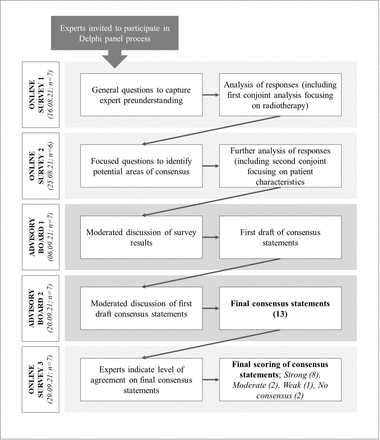
Delphi study to identify consensus on patient selection for hydrogel rectal spacer use during radiation therapy for prostate cancer in the UK
Source : https://bmjopen.bmj.com/content/12/7/e060506
Objectives To identify consensus on patient prioritisation for rectal hydrogel spacer use during radiation therapy for the treatment of prostate cancer in the UK. Design Delphi study consisting of two...
Conclusion: There is a strong and general agreement that all patients with prostate cancer undergoing radical radiation therapy have the potential to benefit from hydrogel spacers. Currently, not all patients who could potentially benefit can access hydrogel spacers, and access is unequal. Implementation of the consensus recommendations would...