



Simultaneous colonic metastasis of advanced gastric cancer: a case report - Surgical Case Reports
Source : https://surgicalcasereports.springeropen.com/articles/10.1186/s40792-023-01622-x
Background Although distant metastasis in gastric cancer can be present at the time of the initial diagnosis, colonic metastasis is extremely rare. This report describes a case of simultaneous colonic...
Conclusions: This was an extremely rare case of simultaneous colonic metastasis of advanced gastric cancer. Because missed metastasis can result in a poorer prognosis, we propose a systemic search including colonoscopy for patients with advanced gastric cancer, especially cases involving poorly differentiated adenocarcinoma or signet ring...
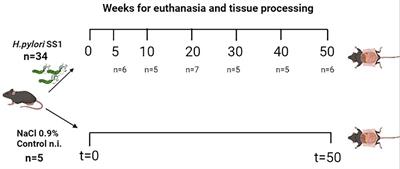
Helicobacter pylori infection induces gastric precancerous lesions and persistent expression of Angpt2, Vegf-A and Tnf-A in a mouse model
Source : https://www.frontiersin.org/articles/10.3389/fonc.2023.1072802/full
IntroductionHelicobacter pylori colonizes the gastric mucosa and induces chronic inflammation. MethodsUsing a mouse model of H. pylori-induced gastritis, we evaluated the mRNA and protein expression levels of proinflammatory and proangiogenic...
Conclusion: Our data show that H. pylori infection induces the expression of Angpt2, Tnf-A and Vegf-A in murine gastric epithelium. This may contribute to the pathogenesis of H. pylori-associated gastritis, however the significance of this should be further addressed.

Xiaotan Sanjie decoction normalizes tumor permissive microenvironment in gastric cancer (Review) - PubMed
Source : https://pubmed.ncbi.nlm.nih.gov/36866751/
Gastric cancer (GC) develops in a complex tissue environment, the tumor microenvironment (TME), which it relies on for persistent proliferation, migration, invasion and metastasis. Non‑malignant stromal cell types within the...
Conclusions/Relevance: Xiaotan Sanjie decoction may be suitable to be added to tumor cell‑directed agents or emerging immunotherapies becoming a desirable modality in the management of GC and acquire improved outcomes for patients with GC.

Role of Ganetespib, an HSP90 Inhibitor, in Cancer Therapy: From Molecular Mechanisms to Clinical Practice - PubMed
Source : https://pubmed.ncbi.nlm.nih.gov/36902446/
Heat-shock proteins are upregulated in cancer and protect several client proteins from degradation. Therefore, they contribute to tumorigenesis and cancer metastasis by reducing apoptosis and enhancing cell survival and proliferation....
Conclusions/Relevance: Ganetespib is a potential cancer therapy that has shown promise in preclinical tests against various cancers, including lung cancer, prostate cancer, and leukemia. It has also shown strong activity toward breast cancer, non-small cell lung cancer, gastric cancer, and acute myeloid leukemia. Ganetespib has been found to...

The multiple combination of Paclitaxel, Ramucirumab and Elacridar reverses the paclitaxel-mediated resistance in gastric cancer cell lines - PubMed
Source : https://pubmed.ncbi.nlm.nih.gov/36874116/
These findings were in line with a greater sensitivity of resistant cells to treatment with both Ramucirumab and Elacridar. Ramucirumab significantly reduced the expression of angiogenic molecules and TUBβIII, while...
Discussion : These findings were in line with a greater sensitivity of resistant cells to treatment with both Ramucirumab and Elacridar. Ramucirumab significantly reduced the expression of angiogenic molecules and TUBβIII, while Elacridar restored the access of chemotherapy, recovering its anti-mitotic and pro-apoptotic effects. Finally,...