



BTK Inhibitors and CAR T-Cell Therapy in Treating Mantle Cell Lymphoma-Finding a Dancing Partner - Current Oncology Reports
Source : https://link.springer.com/article/10.1007/s11912-022-01286-0
Purpose of Review This review focuses on the feasibility of combining Bruton's tyrosine kinase (BTK) inhibitors (BTKis) with chimeric antigen receptor (CAR) T-cell therapy in patients with relapsed or refractory...
Summary: As BTKis and CAR T-cell therapy become mainstays in R/R MCL therapy, combination treatment strategies should be evaluated for their potential benefit in R/R MCL.

SOHO State of the Art Updates and Next Questions | Management of Most Difficult Cases of Chronic Lymphocytic Leukemia: Relapse After Both BTK and BCL2 Inhibition and Richter Transformation - PubMed
Source : https://pubmed.ncbi.nlm.nih.gov/35577753/
The introduction of targeted therapies in chronic lymphocytic leukemia (CLL) has ushered in a new era in which patients achieve better control of their disease, survive longer, and experience fewer...
Relevance: Emerging novel therapies, including reversible BTK inhibitors and CAR T cell therapy, are discussed.

Improved Electrophile Design for Exquisite Covalent Molecule Selectivity - PubMed
Source : https://pubmed.ncbi.nlm.nih.gov/35587148/
Covalent inhibitors are viable therapeutics. However, off-target reactivity challenges the field. Chemists have attempted to solve this issue by varying the reactivity attributes of electrophilic warheads. Here, we report the...
Relevance: Using the scaffold of the Bruton's tyrosine kinase (BTK) inhibitor Ibrutinib for our proof-of-concept, we reasoned that increasing the steric bulk of fumarate-based electrophiles on Ibrutinib should improve selectivity via the steric exclusion of off-targets but retain rates of cysteine reactivity comparable to that of an acrylamide.
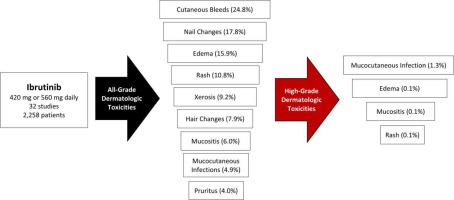
Ibrutinib-associated dermatologic toxicities: A systematic review and meta-analysis
Source : https://www.sciencedirect.com/science/article/abs/pii/S1040842822001202?via=ihub
Ibrutinib-associated dermatologic toxicities are common * Toxicities included cutaneous bleeds, mucocutaneous infections, and nail changes * High-grade toxicities included mucocutaneous infections, rash, mucositis, and edema * Toxicity identification and management...
Relevance: It is imperative that clinicians familiarize themselves with ibrutinib-associated dermatologic toxicities to learn how to manage them, prevent discontinuation, and improve patient outcomes.
-
Leukemia and Lymphoma Connect4yrKey Points • Source: Critical Reviews in Oncology/Hematology • Conclusion: “It is imperative that clinicians familiarize themselves with ibrutinib-associated dermatologic toxicities to learn how to manage them, prevent discontinuation, and improve patient outcomes.” • This systematic Show More

Venetoclax: A Novel Therapeutic Agent for CLL with CNS Involvement
Source : https://www.ncbi.nlm.nih.gov/pmc/articles/PMC9035958/
Chronic lymphocytic leukemia (CLL) involves the proliferation of a clonal population of B cells within the bone marrow that classically spreads to the blood and lymphatic system. Central nervous system...
Conclusion: A favorable pharmacologic profile, selective biologic activity, and potent CNS penetration collectively distinguish venetoclax as a promising therapeutic agent for CLL meningitis. We therefore propose that venetoclax be considered as a first-line agent in this unique clinical setting.