



Regular Aspirin Use and Mortality in Multiple Myeloma Patients
Source : https://cebp.aacrjournals.org/content/early/2021/12/03/1055-9965.EPI-21-0946
Background: Inflammation is important in multiple myeloma (MM) pathogenesis, and regular aspirin use has been shown to confer a reduced risk of MM. The influence of aspirin on survival after...
Conclusions: Findings support the use of aspirin as a complementary strategy to enhance MM survival. Impact: Confirmation in samples that have comprehensive clinical information is encouraged.
Assessing the prognostic utility of smoldering multiple myeloma risk stratification scores applied serially post diagnosis - Blood Cancer Journal
Source : https://www.nature.com/articles/s41408-021-00569-2
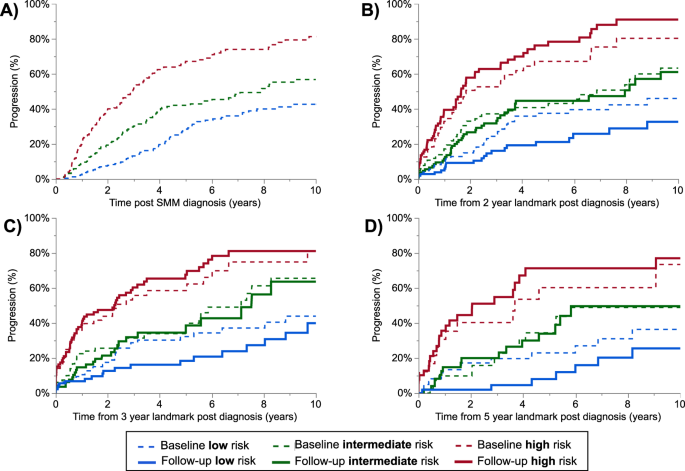
The Mayo-2018 smoldering multiple myeloma (SMM) risk score is used routinely in the clinical setting but has only been validated at diagnosis. In SMM patients, the progression risk decreases over...
Conclusion/Relevance: In conclusion, we showed that the Mayo 2018 and IMWG 2020 risk stratification models can be applied for up to 5 years post SMM diagnosis. Furthermore, we showed that patients migrating to a higher risk category have an increased risk of progression, suggesting that if patients evolve to a high-risk score during follow-up,...
Molecular Mechanisms of Cereblon-Interacting Small Molecules in Multiple Myeloma Therapy
Source : https://www.mdpi.com/2075-4426/11/11/1185
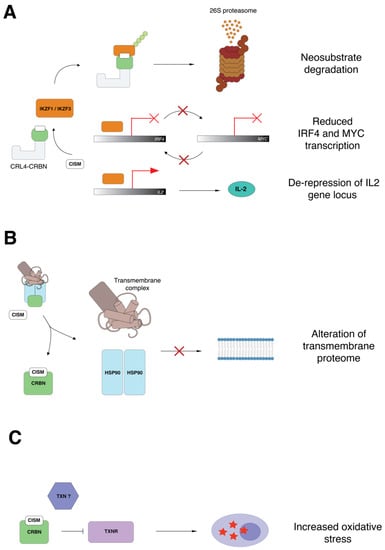
Thalidomide analogues (or immunomodulatory imide drugs, IMiDs) are cornerstones in the treatment of multiple myeloma (MM). These drugs bind Cereblon (CRBN), a receptor for the Cullin-ring 4 ubiquitin-ligase (CRL4) complex,...
Conclusion/Relevance: Thalidomide analogues (or immunomodulatory imide drugs, IMiDs) are cornerstones in the treatment of multiple myeloma (MM). These drugs bind Cereblon (CRBN), a receptor for the Cullin-ring 4 ubiquitin-ligase (CRL4) complex, to modify its substrate specificity. IMiDs mediate CRBN-dependent engagement and proteasomal...

AntagomiR-19a Induced Better Responsiveness to Bortezomib in Myeloma Cell Lines - PubMed
Source : https://pubmed.ncbi.nlm.nih.gov/34837676/
2021 Oct;23(5):503-509. doi: 10.22074/cellj.2021.7302. 1 Department of Haematology and Blood Banking, Faculty of Medical Sciences, Tarbiat Modares University, Tehran, Iran. 2 Department of Haematology and Blood Banking, Faculty of Medical...
Conclusion/Relevance: OncomiR-19a, as a biomarker, may induce better responsiveness to BTZ in myeloma cell lines through its targets SOCS3, STAT3 and PTEN. In the future, this biomarker may provide new therapeutic targets for MM.

Isatuximab: Nursing Considerations for Use in the Treatment of Multiple Myeloma - PubMed
Source : https://pubmed.ncbi.nlm.nih.gov/34800109/
Background: Isatuximab is a CD38 monoclonal antibody approved for use in combination with pomalidomide plus dexamethasone to treat adults with relapsed/refractory multiple myeloma who have received at least two prior...
Conclusions:Nursing care of patients prescribed isatuximab includes monitoring of clinical and laboratory parameters and requires knowledge and management of associated adverse events, including infusion reactions and neutropenia. This information could aid oncology nurses in providing optimal, treatment-specific education to patients and...