



Innovation in BCMA CAR-T therapy: Building beyond the Model T - PubMed
Source : https://pubmed.ncbi.nlm.nih.gov/36505779/
Autologous chimeric antigen receptor T-cell (CAR-T) therapies targeting B-cell maturation antigen (BCMA) have revolutionized the field of multiple myeloma in the same way that the Ford Model T revolutionized the...
Conclusions: Conclusions/Relevance: Just as the Model T set a benchmark for car manufacturing over 100 years ago, idecabtagene vicleucel and ciltacabtagene autoleucel have now set the starting point for BCMA CAR-T therapy with their approvals. As with any emerging technology, whether automotive or cellular, the best in innovation and...

LocoMMotion: a prospective, non-interventional, multinational study of real-life current standards of care in patients with relapsed and/or refractory multiple myeloma - PubMed
Source : https://pubmed.ncbi.nlm.nih.gov/35332278/
Despite treatment advances, patients with multiple myeloma (MM) often progress through standard drug classes including proteasome inhibitors (PIs), immunomodulatory drugs (IMiDs), and anti-CD38 monoclonal antibodies (mAbs). LocoMMotion (ClinicalTrials.gov identifier: NCT04035226)...
Relevance: Despite treatment advances, patients with multiple myeloma (MM) often progress through standard drug classes including proteasome inhibitors (PIs), immunomodulatory drugs (IMiDs), and anti-CD38 monoclonal antibodies (mAbs). LocoMMotion is the first prospective study of real-life standard of care (SOC) in triple-class exposed (received...
New and emerging pharmacotherapies for management of multiple myeloma
You do not currently have access to this article. Subscription prices and ordering for this journal Don't already have an Oxford Academic account? Register New and emerging pharmacotherapies for management...
Conclusion: Several therapeutic agents have been recently approved by the Food and Drug Administration for the treatment of multiple myeloma. There are many novel agents in the pipeline, including bispecific antibodies and CAR T-cell therapies that have the potential to continue to change the treatment landscape of multiple myeloma.

Highly expressed genes in multiple myeloma cells - what can they tell us about the disease? - PubMed
Source : https://pubmed.ncbi.nlm.nih.gov/35276027/
Cancer cells can convert proto-oncoproteins into oncoproteins by increasing the expression of genes that are oncogenic when expressed at high levels. Such genes can promote oncogenesis without being mutated. To...
Conclusion/Relevance: Many well-known "myeloma genes" such as MCL1, CXCR4, TNFRSF17, SDC1, SLAMF7, PTP4A3, and XBP1 were identified as highly expressed, and we believe that hitherto unrecognized key players in myeloma pathogenesis are also enriched on the list. Highly expressed genes in malignant plasma cells that were absent or expressed at...
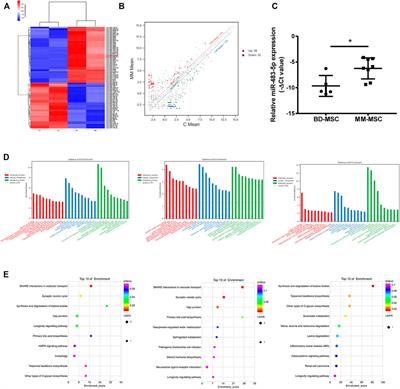
Exosomal miR-483-5p in Bone Marrow Mesenchymal Stem Cells Promotes Malignant Progression of Multiple Myeloma by Targeting TIMP2
Source : https://www.frontiersin.org/articles/10.3389/fcell.2022.862524/full
Bone marrow-derived mesenchymal stem cell (BMSC) is one crucial component of the multiple myeloma (MM) microenvironment and supports the malignant progression of MM. Whether BMSCs act on MM cells via...
Conclusion/Relevance: In summary, our study indicated that MM-MSCs promote MM malignant progression via the release of exosomes and regulation of miR-483-5p/TIMP2 axis, suggesting an essential role of BMSCs derived exosomal miRNA in MM and a potential marker for MM diagnosis and therapy.