


Clinical Utility Validation of an Automated Ultrarapid Gene Fusion Assay for NSCLC
Source : https://www.jtocrr.org/article/S2666-3643(22)00158-8/fulltext
Gene rearrangements are frequent oncologic drivers in NSCLC, and many are suitable for treatment with Food and Drug Administration-approved or experimental targeted therapies. We evaluated the accuracy, specimen acceptance profile,...
Conclusions: The rapid fusion assay is quick, accurate, and versatile, allowing reliable detection of ALK, ROS1, RET fusions, and MET exon 14 skipping in NSCLC, and NTRK fusions. Rapid molecular testing may expedite treatment with appropriate targeted therapies.
Case report: Recurrent lung infections following treatment with pralsetinib for an elderly patient with RET-fusion positive NSCLC
Source : https://www.frontiersin.org/articles/10.3389/fonc.2022.1024365/full
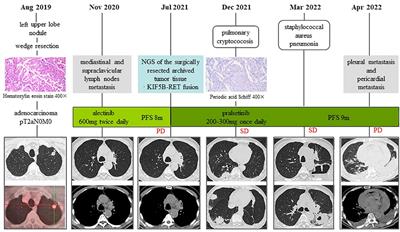
Patients with RET fusions represent 1-2% of all cases of non-small cell lung cancer (NSCLC), the majority of whom are younger, and are extremely rare in the elderly. As a...
Conclusions: Our study demonstrates that pralsetinib is an effective therapeutic option that provides survival benefits for elderly NSCLC patients harboring RET fusion. However, during pralsetinb therapy, treating physicians should maintain particular vigilance for the increased risk of infection, especially in elderly patients.

Targeted therapy of RET fusion-positive non-small cell lung cancer - PubMed
Source : https://pubmed.ncbi.nlm.nih.gov/36582799/
Lung cancer has very high morbidity and mortality worldwide, and the prognosis is not optimistic. Previous treatments for non-small cell lung cancer (NSCLC) have limited efficacy, and targeted drugs for...
Conclusions: This review will describe the basic characteristics and common fusion methods of RET genes; analyze the advantages and disadvantages of different RET fusion detection methods; summarize and discuss the recent application of non-selective and selective RET fusion-positive inhibitors, such as Vandetanib, Selpercatinib, Pralsetinib and...
RET fusion mutation detected by re-biopsy 7 years after initial cytotoxic chemotherapy: A case report
Source : https://www.frontiersin.org/articles/10.3389/fonc.2022.1019932/full
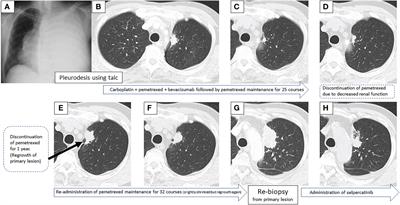
Personalized medicine using molecular-targeted drugs to achieve better therapeutic response and long-term prognosis is common practice for lung cancer treatment. However, in cases before gene batch tests were available, medical...
Relevance: We describe a case of RET fusion-positive lung cancer where molecular targeted therapy and cytotoxic drug showed a drastic response and long-term therapy was well maintained. Next generation sequencing was able to correctly diagnose RET fusion mutation using re-biopsy specimen after going undiagnosed for 7 years.

Molecular pathways, resistance mechanisms and targeted interventions in non-small-cell lung cancer - Molecular Biomedicine
Source : https://link.springer.com/article/10.1186/s43556-022-00107-x
Lung cancer is the leading cause of cancer-related mortality worldwide. The discovery of tyrosine kinase inhibitors effectively targeting EGFR mutations in lung cancer patients in 2004 represented the beginning of...
Relevance: In this review, we manage to display the current landscape of targetable therapeutic patterns in NSCLC in this era of precision medicine.