



Targeting FGFR2 positive gastroesophageal cancer | OTT
Gastroesophageal cancer encompasses three major subdivisions which are histologically, epidemiologically, and pathologically different: gastric adenocarcinoma, gastroesophageal junctional (GEJ) adenocarcinoma and oesophageal cancer, which is further classified into squamous cell carcinoma...
Relevance: In our review, we outline the FGFR pathway and focus on the developments and challenges of targeting FGFR2 driven gastroesophageal cancers.
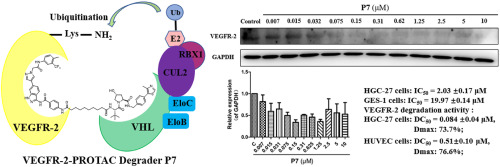
Discovery of novel VEGFR-2-PROTAC degraders based on the localization of lysine residues via recruiting VHL for the treatment of gastric cancer
Source : https://www.sciencedirect.com/science/article/abs/pii/S0223523422007231?via=ihub
A library of VEGFR-2-PROTAC degraders based on the lysine residues were designed. * P7 degraded VEGFR-2 protein by the formation of ternary complex and the ubiquitin-proteasome pathway. * P7 shortened...
/>
Conclusions: All the results demonstrated that P7 could be as a promising VEGFR-2-PROTAC degrader for gastric cancer therapy.

Building Palliative Care Capacity for Generalist Providers in the Community: Results From the Capaciti Pilot Education Program - PubMed
Source : https://pubmed.ncbi.nlm.nih.gov/36269212/
Objective: Primary care providers play an important role in providing early palliative care, however they often lack practical supports to operationalize this approach in practice. CAPACITI is a virtual training...
Conclusion: CAPACITI improved self-assessed palliative care identification and provider confidence in core competencies. The program demonstrated potential for building palliative care capacity in primary care teams.
αVEGFR2-MICA fusion antibodies enhance immunotherapy effect and synergize with PD-1 blockade - Cancer Immunology, Immunotherapy
Source : https://link.springer.com/article/10.1007/s00262-022-03306-1
Antiangiogenic therapy has shown significant clinical benefits in gastric cancer (GC) and non-small cell lung cancer (NSCLC). However, their effectiveness is limited by the immunosuppressive tumor microenvironment. The MHC class...
Relevance: Antiangiogenic therapy has shown significant clinical benefits in gastric cancer (GC) and non-small cell lung cancer (NSCLC). However, their effectiveness is limited by the immunosuppressive tumor microenvironment. The MHC class I chain-related molecules A and B (MICA/B) are expressed in many human cancers, enabling elimination of...

Successes and failures of angiogenesis blockade in gastric and gastro-esophageal junction adenocarcinoma - PubMed
Source : https://pubmed.ncbi.nlm.nih.gov/36212393/
Gastric and gastro-esophageal junction adenocarcinoma (GEA) remains a considerable major public health problem worldwide, being the fifth most common cancer with a fatality-to-case ratio that stands still at 70%. Angiogenesis,...
Conclusion/Relevance: We critically review the existing literature on the biological rationale and clinical development of antiangiogenic agents in GEA, discussing major achievements, limitations and future developments, aiming at fully realizing the potential of this therapeutic approach.