



Waldenström Macroglobulinemia - 2021 Update on Management and Future Directions - PubMed
Source : https://pubmed.ncbi.nlm.nih.gov/34980578/
Waldenstrom macroglobulinemia (WM) is a low-grade B-cell lymphoproliferative disorder. It is defined by having ≥ 10% bone marrow infiltration with lymphoplasmacytic cells and/or an immunoglobulin M (IgM) monoclonal gammopathy of...
Conclusion/Relevance: Selection among available regimens should take patients' gene mutation profile, disease-related features, and co-morbid conditions into account. Promising novel therapies in development include non-covalent BTK inhibitors, CXCR4 antagonists, BCL 2 inhibitors, bi-specific antibodies, radioimmunoconjugates, and CD19- and...
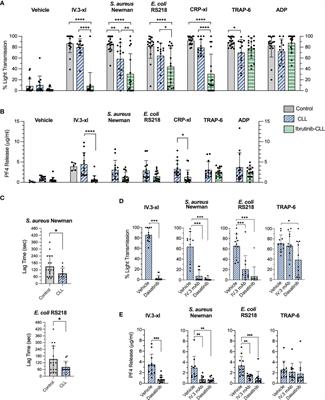
Bruton's Tyrosine Kinase Inhibitors Impair FcγRIIA-Driven Platelet Responses to Bacteria in Chronic Lymphocytic Leukemia
Source : https://www.frontiersin.org/articles/10.3389/fimmu.2021.766272/full
Bacterial infections are a major cause of morbidity and mortality in chronic lymphocytic leukemia (CLL), and infection risk increases in patients treated with the Bruton's tyrosine kinase (Btk) inhibitor, ibrutinib....
Conclusion/Relevance: Our data suggest that ibrutinib impairment of FcγRIIA-mediated platelet activation by bacteria results from a combination of Btk and Tec inhibition, although off-target effects on additional kinases cannot be discarded. This is potentially relevant to control infection-risk in CLL patients and, thus, future studies should...
![Discovery of pyrido[3,4-b]indol-1-one derivatives as novel non-covalent Bruton's tyrosine kinase (BTK) inhibitors - PubMed](https://static-content-prd.skipta.com/public/skipta/skipta-post/2023-12/fileCZeLY5 "Discovery of pyrido[3,4-b]indol-1-one derivatives as novel non-covalent Bruton's tyrosine kinase (BTK) inhibitors - PubMed")
Discovery of pyrido[3,4-b]indol-1-one derivatives as novel non-covalent Bruton's tyrosine kinase (BTK) inhibitors - PubMed
Source : https://pubmed.ncbi.nlm.nih.gov/34910982/
Bruton's tyrosine kinase (BTK) is an attractive target for the treatment of malignancy and inflammatory/autoimmune diseases. Most of the covalent BTK inhibitors would induce off-target side effects and drug resistance....
Conclusion: In all, the new pyrido[3,4-b]indol-1-one derivatives have the antitumor potency by BTK inhibition and were worthy of further exploration.

Bruton Tyrosine Kinase Inhibitors in B-Cell Malignancies: Their Use and Differential Features - Targeted Oncology
Source : https://link.springer.com/article/10.1007/s11523-021-00857-8
Starting with the first-in-class agent ibrutinib, the development of Bruton tyrosine kinase (BTK) inhibitors has led to dramatic improvements in the management of B-cell malignancies. Subsequently, more-highly selective second-generation BTK...
Conclusion/Relevance: This review article summarises the evidence supporting the role of BTK inhibitors in the management of B-cell malignancies, including highlighting some differential features between agents.

BTK and PI3K Inhibitors Reveal Synergistic Inhibitory Anti-Tumoral Effects in Canine Diffuse Large B-Cell Lymphoma Cells - PubMed
Source : https://pubmed.ncbi.nlm.nih.gov/34884478/
Bruton's tyrosine kinase (BTK) and phosphoinositide 3-kinase (PI3K) in the B-cell receptor (BCR) signaling pathway are considered potential therapeutic targets for the treatment of B-cell lymphomas, among which, diffuse large...
Conclusion/Relevance: The combination of ibrutinib and AS-605240 represents a promising approach that warrants further in vivo evaluation in dogs, potentially bearing significant value for the treatment of human DLBCL.