



Next Generation BTK Inhibitors in CLL: Evolving Challenges and New Opportunities - PubMed
Source : https://pubmed.ncbi.nlm.nih.gov/36900295/
Ibrutinib revolutionized the CLL treatment approach and prognosis demonstrating its efficacy and safety even at extended follow-up. During the last few years, several next-generation inhibitors have been developed to overcome...
Conclusions/Relevance: New mechanisms for BTK inhibition are under investigations in patients progressing with both covalent and non-covalent BTK and BCl2 inhibitors. Here we summarize and discuss results from main experiences on irreversible and reversable BTK inhibitors in CLL.

Primary Mediastinal B-Cell Lymphoma in Children and Young Adults - PubMed
Source : https://pubmed.ncbi.nlm.nih.gov/36898366/
Primary mediastinal B-cell lymphoma (PMBCL) is a rare but aggressive mature B-cell lymphoma that arises from thymic B cells and most commonly affects adolescents and young adults. PMBCL is now...
Conclusions/Relevance: Novel agents are currently being studied in PMBCL with the goal of improving outcomes and reducing reliance on radiation and/or high-dose chemotherapy. Immune checkpoint blockade with PD-1 inhibition is of particular interest given the upregulation of PD-L1 in PMBCL and the known efficacy of these agents in the relapsed...

Prognosis and complications of patients with primary gastrointestinal diffuse large B-cell lymphoma: Development and validation of the systemic inflammation response index-covered score - PubMed
Source : https://pubmed.ncbi.nlm.nih.gov/36866830/
The results of this analysis suggested that the pretreatment SIRI may be a potential candidate for identifying patients with a poor prognosis. And we established and validated a better-performing clinical...
Conclusions: The results of this analysis suggested that the pretreatment SIRI may be a potential candidate for identifying patients with a poor prognosis. And we established and validated a better-performing clinical model, which facilitated the prognostic stratification of PGI-DLBCL patients and can serve as a reference for clinical...
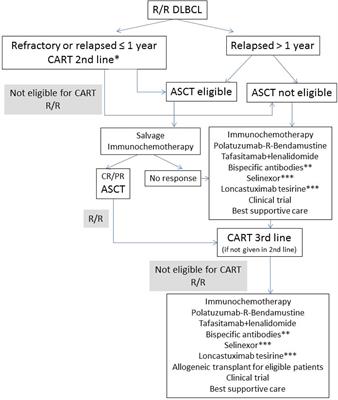
Role of Bispecific Antibodies in Relapsed/Refractory Diffuse Large B-Cell Lymphoma in the CART Era
Source : https://www.frontiersin.org/articles/10.3389/fimmu.2022.909008/full
Diffuse large B-cell lymphoma is an aggressive and biologically heterogeneous disease. R-CHOP is the standard first line therapy and cures more than 60% of patients. Salvage high-dose chemotherapy with autologous...
Conclusions: BsAbs have emerged as a novel class of off-the-shelf immunotherapies with a manageable safety profile, and clear efficacy in R/R aggressive B-cell lymphomas, including in those patients relapsing after CART therapy. There are still many open questions, and new trials are currently ongoing to confirm BsAbs efficacy and...

Survival outcomes of patients newly diagnosed with diffuse large B-cell lymphoma: real-world evidence from a German claims database - Journal of Cancer Research and Clinical Oncology
Source : https://link.springer.com/article/10.1007/s00432-023-04660-y
Purpose Diffuse large B-cell lymphoma (DLBCL) is the most common subtype of non-Hodgkin lymphoma with increasing incidence. Although the burden of disease is high, only limited current real-world data on...
Conclusions: DLBCL-associated mortality is still high, especially in relapsed patients and in the elderly. Therefore, there is a high medical need for new effective treatments that can improve survival outcomes in DLBCL patients.