



Prognostic impact of early minimal residual disease combined with complete molecular evaluation in acute myeloid leukemia with mutated NPM1: a single center study - PubMed
Source : https://pubmed.ncbi.nlm.nih.gov/35459427/
doi: 10.1080/10428194.2022.2064987. Online ahead of print. 1 Sorbonne Université, INSERM, Centre de Recherche Saint-Antoine, AP-HP, Hôpital Saint-Antoine, Service d'hématologie clinique et de thérapie cellulaire, Paris, France. 2 Department of Medicine...
Conclusion/Relevance: We evaluated prognostic factors in 83 intensively treated adult patients with NPM1 mutated AML. Targeted next-generation sequencing revealed high frequency of co-mutations in epigenetic modifiers or proliferation pathways. NPM1 minimal residual disease (MRD), assessed in bone marrow by specific polymerase chain reaction...
Cytogenetics or MRD in B-cell ALL. Do both reign supreme? - Leukemia
Source : https://www.nature.com/articles/s41375-022-01575-4
Cytogenetic aberrations were first recognized as dominant leukemia drivers by the late Dr. Janet Rowley 49 years ago [ 1]. Numerous cytogenetic aberrations have since been identified across all cancer...
Conclusion: Despite the prevailing assumption that achievement of MRD supersedes other known prognostic factors, the novel cytogenetic classification proposed in this important study reiterates the significance of segregating adults with B-ALL into genetically-driven risk groups right at presentation. Such ongoing progress will hopefully foster,...
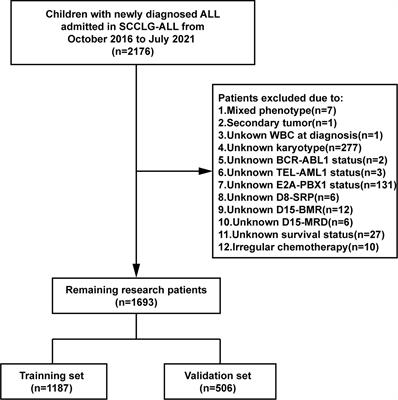
A Nomogram for Predicting Event-Free Survival in Childhood Acute Lymphoblastic Leukemia: A Multicenter Retrospective Study
Source : https://www.frontiersin.org/articles/10.3389/fonc.2022.854798/full
ObjectiveEven though childhood acute lymphoblastic leukemia (ALL) has an encouraging survival rate in recent years, some patients are still at risk of relapse or even death.
Conclusion: The nomogram for predicting EFS of children with ALL has good performance and clinical utility. The model could help clinical decision-making.
Post-transplant day +100 MRD detection rather than mixed chimerism predicts relapses after allo-SCT for intermediate risk AML patients transplanted in CR
Source : https://www.sciencedirect.com/science/article/abs/pii/S2666636722012258?via=ihub
Available online 13 April 2022 * full donor chimerism can mitigate negative impact of pre-transplant MRD positivity * qPCR-MRD is more predictive for post-transplant relapse than MFC-MRD * mixed chimerism...
Conclusions: In intermediate-risk AML, the qPCR-MRD on day 100 is highly predictive for relapse and long-term survival after allo-SCT, closely followed by MFC-MRD. In contrast, the chimerism status has limited predictive potential. Thus, molecular and flow-cytometric MRD monitoring in the first months post-transplant rather than MC is able to...
Pretransplantation minimal residual disease monitoring by multiparameter flow cytometry predicts outcomes of AML patients receiving allogeneic hematopoietic stem cell transplantation
Source : https://www.sciencedirect.com/science/article/abs/pii/S0966327422000703?via=ihub
Achieving MFC-MRD <10 −3 − before allo-HSCT could reduce the relapse of AML and improve OS and DFS significantly. * Haplo-HSCT reduced the CIR, OS and DFS disparities between MRD...
Conclusion: It is suggested that achieving MFC-MRD