



Clinical application of next-generation sequencing-based monitoring of minimal residual disease in childhood acute lymphoblastic leukemia - Journal of Cancer Research and Clinical Oncology
Source : https://link.springer.com/article/10.1007/s00432-022-04151-6
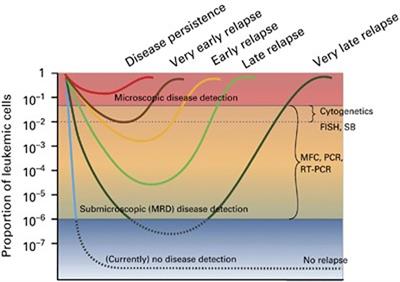
Background Next-generation sequencing (NGS) is an emerging technology that can comprehensively assess the diversity of the immune system. We explored the feasibility of NGS in detecting minimal residual disease (MRD)...
Conclusion: NGS is more sensitive than MFC and RQ–PCR for MRD measurement. B-ALL children with ≧2 clonal rearrangements detected by NGS before treatment are difficult to switch to negative MRD after chemotherapy.
MRD in Venetoclax-Based Treatment for AML: Does it Really Matter?
Source : https://www.frontiersin.org/articles/10.3389/fonc.2022.890871/full
The prognosis of newly diagnosed patients with acute myeloid leukemia is still unfavorable in the majority of cases within the intermediate and mainly adverse genetic risk group but also in...
Relevance: We here review and discuss more recent data on the minimal residual disease interpretation and role in AML patients treated with venetoclax-based combinations.

Molecular Measurable Residual Disease Assessment before Hematopoietic Stem Cell Transplantation in Pediatric Acute Myeloid Leukemia Patients: A Retrospective Study by the I-BFM Study Group - PubMed
Source : https://pubmed.ncbi.nlm.nih.gov/35884834/
Hematopoietic stem cell transplantation (HSCT) is a curative post-remission treatment in patients with acute myeloid leukemia (AML), but relapse after transplant is still a challenging event. In recent year, several...
Conclusion/Relevance: Here, we propose the first collaborative retrospective I-BFM-AML study assessing qPCR-MRD values in pretransplant bone marrow samples of 112 patients with a diagnosis of AML ….These data support the PCR-based approach playing a clinical relevance in AML transplant management.

Clinical Impact of Measurable Residual Disease in Acute Myeloid Leukemia - PubMed
Source : https://pubmed.ncbi.nlm.nih.gov/35892893/
Measurable residual disease (MRD) has emerged as a primary marker of risk severity and prognosis in acute myeloid leukemia (AML). There is, however, ongoing debate about MRD-based surveillance and treatment....
Conclusion: Several studies address the implications of MRD on treatment selection and hematopoietic stem cell transplant, including patient candidacy, conditioning regimen, and transplant type. More prospective, randomized studies are needed to guide the application of MRD in the treatment of AML, particularly in transplant.

Circulating DNA in the neoadjuvant setting of early stage colon cancer
Source : https://www.tandfonline.com/doi/abs/10.1080/0284186X.2022.2101023?journalCode=ionc20
Abstract While circulating tumour (ct)DNA is an indicator of minimal residual disease and negative prognostic factor in stage II-III colon cancer, no study has ever analysed the value of this...
Conclusion/Relevance: While circulating tumour (ct)DNA is an indicator of minimal residual disease and negative prognostic factor in stage II-III colon cancer, no study has ever analysed the value of this biomarker in colon cancer patients treated with neoadjuvant chemotherapy …. This is the first study of ctDNA in the neoadjuvant setting of...