



Minimal residual disease in patients with diffuse large B-cell lymphoma undergoing autologous stem cell transplantation
Research Article | Reid W Merryman, Robert A Redd, Eleanor Taranto, Gulrayz Ahmed, Erin Jeter, Kristin M McHugh, Jennifer R. Brown, Jennifer L. Crombie, Matthew S. Davids, David C. Fisher,...
Conclusions: Detection of MRD in ASC samples is associated with a very high relapse risk, justifying alternative treatment strategies or trials of novel consolidation options in those patients. Furthermore, post-ASCT MRD monitoring may facilitate trials evaluating early initiation of treatment at molecular relapse.

Go with the Flow-Early Assessment of Measurable Residual Disease in Children with Acute Lymphoblastic Leukemia Treated According to ALL IC-BFM2009 - PubMed
Source : https://pubmed.ncbi.nlm.nih.gov/36358778/
Measurable residual disease (MRD) is a well-known tool for the evaluation of the early response to treatment in patients with acute lymphoblastic leukemia (ALL). In respect to predicting the relapse...
Conclusions: Conclusions/Relevance: Measurement of MRD at early time points can be used with simplified genetic analysis to better identify low and high-risk patients, allowing personalized therapies and further improvement in outcomes in pediatric ALL.

Performance status, comorbidities, and cycles of methotrexate exert the greatest influence on outcomes of primary and secondary CNS lymphomas: the Lexington experience - PubMed
Source : https://pubmed.ncbi.nlm.nih.gov/36367559/
Primary central nervous system lymphoma (PCNSL) occurs primarily in older patients and has a worse prognosis than other extranodal lymphomas. Contemporary treatment is based on high-dose methotrexate (HD-MTX), which crosses...
Conclusions: Our study is in line with the recent literature and confirms ongoing challenges. We discuss how the outcomes of CNS lymphomas can be improved.
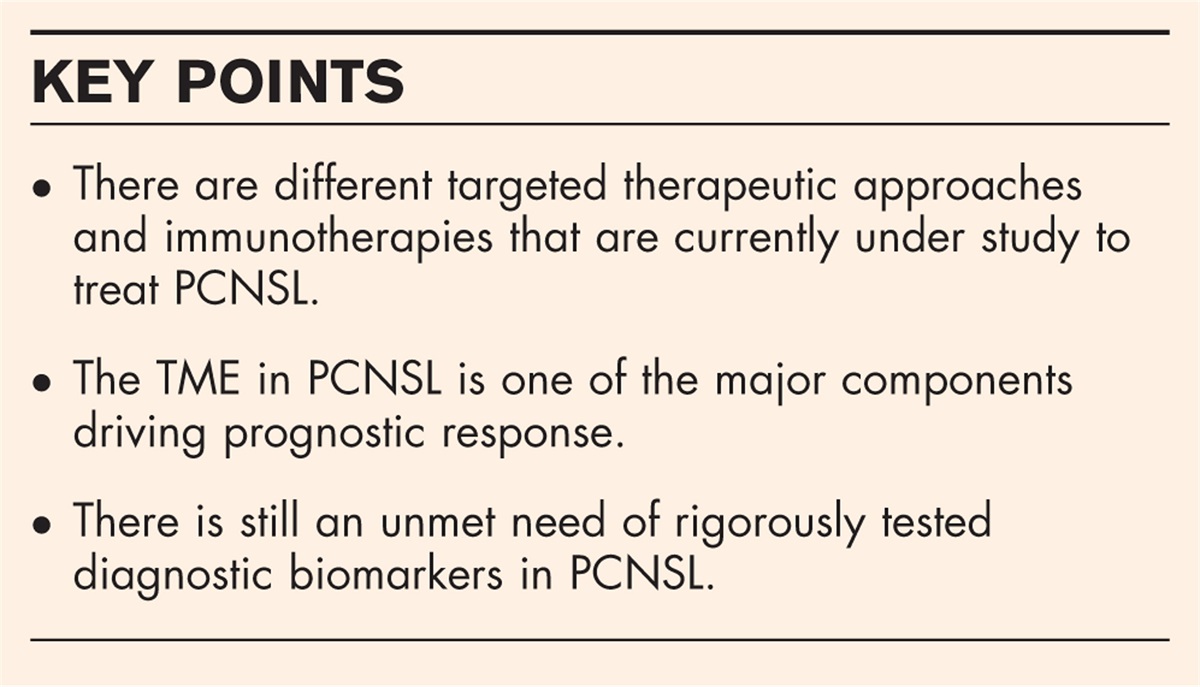
Primary central nervous system lymphoma: advances in its... : Current Opinion in Neurology
This article reviews current work on the pathogenesis of the disease, potential biomarkers, and treatments. Recent findings Previous molecular classifications of PCNSL, built on DLBCL heterogeneity, did not properly address...
Conclusions: Summary: Despite the increasing understanding of PCNSL pathogenesis with recent studies, future efforts are still needed to yield diagnostic biomarkers to detect either PCNSL or its molecular subtypes and hence ease routine clinical use.

Synthesis and Biological Evaluation of PEGylated MWO4 Nanoparticles as Sonodynamic AID Inhibitors in Treating Diffuse Large B-Cell Lymphoma - PubMed
Source : https://pubmed.ncbi.nlm.nih.gov/36363970/
Sonodynamic therapy (SDT) triggered by ultrasound (US) has attracted increasing attention owing to its ability to overcome critical limitations, including low tissue-penetration depth and phototoxicity in photodynamic therapy (PDT). Biogenic...
Conclusions:The anti-lymphoma studies using DLBCL and AID-deficient DLBCL cell lines indicated a concentration-dependent profile. The synthesized MWO4-PEG NPs in this study manifested good sonodynamic inhibitory effects to AID and well treatment for AID-positive hematopoietic cancers.