


A systematic genome-wide mapping of oncogenic mutation selection during CRISPR-Cas9 genome editing - Nature Communications
Source : https://www.nature.com/articles/s41467-021-26788-6
CRISPR-Cas9 gene editing can induce a p53 mediated damage response. Here the authors investigate the possibility of selection of pre-existing cancer driver mutations during CRISPR-Cas9 knockout based gene editing and identify KRAS mutants that may confer a selected advantage to edited cells.
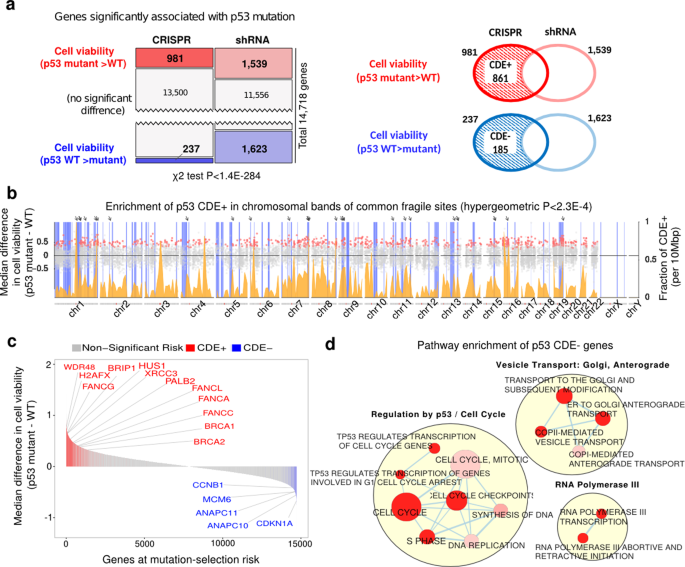
Conclusion/Relevance:In this study, we systematically investigated the possibility of selection of pre-existing cancer driver mutations during CRISPR-Cas9 gene editing. First, we confirmed and extended upon previous findings that selection13,14,15 of pre-existing p53 mutations by CRISPR-Cas9 can happen, showing it in a large set of transformed and non-transformed cell lines. We identified the specific CDE genes whose CRISPR-KO is likely to mediate such selection, and further tested and validated some of these predictions in new screens and competitive assays that we have performed. After studying and validating our integrated computational and experimental pipeline in the known case of p53, we turned to applying it to study a collection of major cancer driver genes and discovered that KRAS is another major cancer driver gene whose pre-existing mutants have a selective advantage during CRISPR-Cas9 gene editing.
• Source: Nature Communications
• Conclusion/Relevance: “In this study, employing an integrated computational and experimental framework, we systematically investigated the possibility of selection of additional cancer driver mutations during CRISPR-Cas9 gene editing. We first confirm the previous findings of the selection for pre-existing p53 mutations by CRISPR-Cas9. We next demonstrate that similar to p53, wildtype KRAS may also hamper the growth of Cas9-edited cells, potentially conferring a selective advantage to pre-existing KRAS-mutant cells.”
• Selective effects are widespread and span cell types and strategies of CRISPR-Cas9 delivery. The strength of selection is due to the sgRNA sequence and edited gene.
• According to the authors, isolating pre-existing p53 or KRAS mutations may confound CRISPR-Cas9 screens in cancer cells. It could necessitate the monitoring of patients receiving CRISPR-Cas9-based editing in clinical contexts for pre-existing p53 and KRAS mutations.