



KRAS-G12C Covalent Inhibitors: A game changer in the scene of cancer therapies - PubMed
Source : https://pubmed.ncbi.nlm.nih.gov/34800654/
RAS is the most frequently mutated oncogene in human cancer. Scientists attempted for decades to target this protein or its pathways, however, all the attempts failed and RAS was labeled...
Conclusion: In 2021, the Food and Drug Administration (FDA) approved the use of Sotorasib (Lumakras) for the treatment of adult patients with KRAS-G12C mutated locally advanced or metastatic NSCLC, following at least one prior systemic therapy. However, and as every other drug, KRAS-G12C inhibitors are facing intrinsic and acquired resistances....

Cholesterol Regulates the Tumor Adaptive Resistance to MAPK Pathway Inhibition
Source : https://pubs.acs.org/doi/10.1021/acs.jproteome.1c00550
Although targeted MAPK pathway inhibition has achieved remarkable patient responses in many cancers, the development of resistance has remained a critical challenge. Adaptive tumor response underlies the drug resistance. Furthermore,...
Together, our findings suggest that cholesterol contributes to the tumor adaptive response upon targeted MAPK pathway inhibitors. These results also suggest that MAPK pathway inhibitors could be combined with cholesterol-lowering agents to achieve a more complete and durable response in tumors with hyperactive MAPK signaling.
-
KRAS Oncogene Connect4yrKey Points • Source: Journal of Proteome Research • Conclusion/Relevance: “[W]e performed a comprehensive characterization of the remodeling of the p-Tyr proteome in melanoma cells treated with various MAPK pathway inhibitors. We showed that Show More

CRISPR-Cas9 Gene Editing May Select for Cells With Cancer-Related Mutations
A comprehensive study headed by researchers at Sanford Burnham Prebys has shown that gene editing-specifically gene knockout (KO)-using CRISPR-Cas9 technology can favor cells with mutated forms of p53 or KRAS...
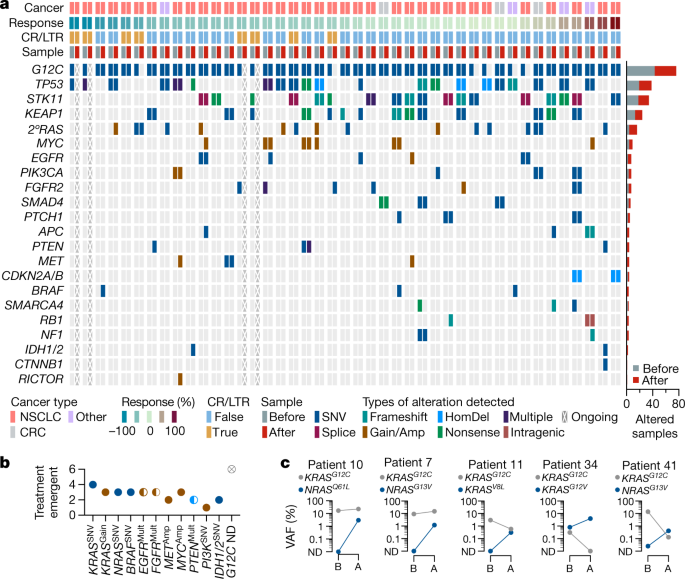
Diverse alterations associated with resistance to KRAS(G12C) inhibition - Nature
Source : https://www.nature.com/articles/s41586-021-04065-2
Inactive state-selective KRAS(G12C) inhibitors1-8 demonstrate a 30-40% response rate and result in approximately 6-month median progression-free survival in patients with lung cancer9. The genetic basis for resistance to these first-in-class...
Our study thus suggests a heterogenous pattern of resistance with multiple subclonal events emerging during G12C inhibitor treatment. A subset of patients in our cohort acquired oncogenic KRAS, NRAS or BRAF mutations, and resistance in this setting may be delayed by co-targeting of ERK signalling intermediates. These findings merit broader...

Diminished efficacy of PD-(L)1 inhibition in STK11- and KEAP1-mutant lung adenocarcinoma is impacted by KRAS mutation status - PubMed
Source : https://pubmed.ncbi.nlm.nih.gov/34740862/
STK11 and KEAP1 mutations confer worse outcomes to immunotherapy among patients with KRAS MUT but not among KRAS WT lung adenocarcinoma. Tumors harboring concurrent KRAS/STK11 and KRAS/KEAP1 mutations display distinct...