


Identification of potential resistance mechanisms and therapeutic targets for the relapse of BCMA CAR-T therapy in relapsed/refractory multiple myeloma through single-cell sequencing - Experimental Hematology & Oncology
Source : https://ehoonline.biomedcentral.com/articles/10.1186/s40164-023-00402-5
Background BCMA CAR-T is highly effective for relapsed/refractory multiple myeloma(R/R-MM) and significantly improves the survival of patients. However, the short remission time and high relapse rate of MM patients treated...
Conclusion: Taken together, our data extend the understanding of intrinsic and extrinsic relapse of BCMA CAR-T treatment in R/R-MM patient and the potential mechanisms involved in the alterations of antigens and the induced immunosuppressive microenvironment, which may provide a basis for the optimization of BCMA CAR-T strategies. Further...

Antibody-Drug Conjugates for Multiple Myeloma: Just the Beginning, or the Beginning of the End? - PubMed
Source : https://pubmed.ncbi.nlm.nih.gov/37111346/
Multiple myeloma is a malignancy of immunoglobulin-secreting plasma cells that is now often treated in the newly diagnosed and relapsed and/or refractory settings with monoclonal antibodies targeting lineage-specific markers used...
Relevance: This contribution will provide an overview of some of the current data supporting the possibility that ADCs will remain a part of our chemotherapeutic armamentarium against myeloma moving forward, and also highlight areas for future development.
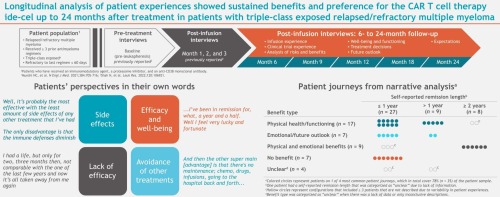
Analysis of patient-reported experiences up to 2 years after receiving idecabtagene vicleucel (ide-cel, bb2121) for relapsed or refractory multiple myeloma: Longitudinal findings from the phase 2 KarMMa trial
Source : https://www.sciencedirect.com/science/article/pii/S0145212623000590?via=ihub
Patients preferred ide-cel to other treatments for efficacy and side effect profile. * Despite impactful side effects, patients still considered ide-cel advantageous. * Quality-of-life improved 6 months after treatment and...
Conclusions: Longitudinal analysis of patient experiences showed sustained benefits and preference for ide-cel up to 24 months after treatment.
The core symptom in multiple myeloma patients undergoing chemotherapy: a network analysis - Supportive Care in Cancer
Source : https://link.springer.com/article/10.1007/s00520-023-07759-7
Background During chemotherapy for multiple myeloma, symptoms include those related to the disease, as well as adverse effects of the treatment. Few studies have explored the relationships between these symptoms....
Implications for Practice: Nurses and health care teams should be a priority to intervene in the worrying for chemotherapy-treated multiple myeloma patients to maximize the effectiveness of an intervention. Except, nausea and vomiting should be managed together in a clinical setting.
Real-life experiences with CAR T-cell therapy with idecabtagene vicleucel (ide-cel) for triple-class exposed relapsed/refractory multiple myeloma patients - BMC Cancer
Source : https://bmccancer.biomedcentral.com/articles/10.1186/s12885-023-10824-3
Background Chimeric antigen receptor (CAR) T-cell therapy has revolutionized the treatment landscape of relapsed/refractory multiple myeloma (RRMM), leading to unprecedented responses in this patient population. Idecabtagene vicleucel (ide-cel) has been...
Conclusions: We report one of the first cohorts of RRMM treated with commercial ide-cel. The ORR was 69% and safety profile was manageable, but prolonged hematologic toxicity still represents a major challenge. Responses correlated with in vivo CAR T cell expansion, underlining the need of further research to optimize CAR T...