


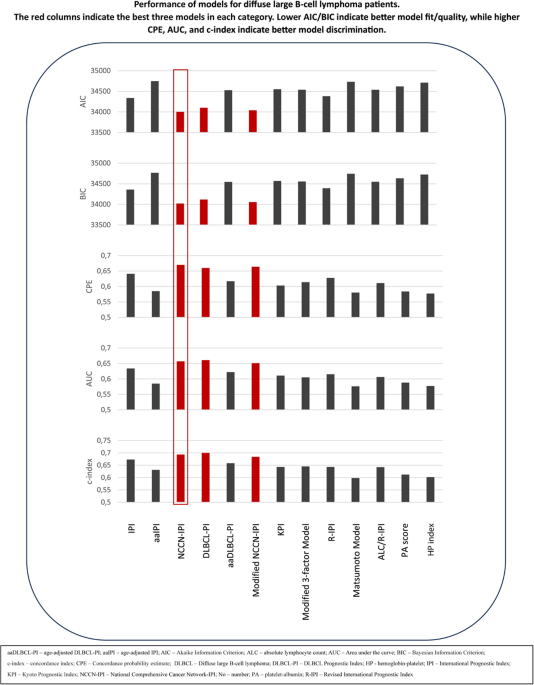
Prognostic Indices in Diffuse Large B-Cell Lymphoma: a Population-Based Comparison and Validation Study of Multiple Models
Source : https://www.nature.com/articles/s41408-023-00930-7
Currently, the International Prognostic Index (IPI) is the most used and reported model for prognostication in patients with newly diagnosed diffuse large B-cell lymphoma (DLBCL). IPI-like variations have been proposed,...
This large retrospective register-based study analyzing 13 prognostic models for DLBCL showed superior model quality and discriminatory ability of NCCN-IPI and DLBCL-PI compared to other models.

Atypical Diffuse Large B-Cell Lymphoma, Primary Splenic Lymphoma Variant: a Case Report
Source : https://www.sciencedirect.com/science/article/pii/S2210261223009902
Primary splenic lymphoma (PSL) is characterized by lymphoma involvement confined to the spleen and hilar lymph nodes, without evidence of liver involv...
This case report emphasizes the importance of considering primary splenic DLBCL as a differential diagnosis in patients presenting with splenomegaly and highlights the significance of multidisciplinary collaboration for accurate diagnosis and optimal management of this uncommon pathology.

Diffuse Large B-Cell Lymphoma, Not Otherwise Specified (DLBCL NOS) Presenting as Multiple Subcutaneous Nodules: an Unusual Cutaneous Presentation of Systemic Disease
Source : https://www.hindawi.com/journals/cripa/2023/2960965/
Diffuse large B-cell lymphoma, not otherwise specified (DLBCL NOS) is the most common lymphoid malignancy in the Western world and classically presents as a rapidly enlarging nodal or extranodal mass....
We describe the case of a 69-year-old man who was seen at our hospital due to generalized weakness and was found to have multiple subcutaneous nodules representing disseminated DLBCL NOS. The case was complicated by concurrent monoclonal B-cell lymphocytosis involving the bone marrow.

Derepressing of STAT3 and USP7 Contributes to Resistance of DLBCL to EZH2 Inhibition
Source : https://www.ncbi.nlm.nih.gov/pmc/articles/PMC10565777/
Diffuse large B-cell lymphoma is the most common subtype of lymphoma, representing ∼25 % of non-Hodgkin lymphoid malignancies. EZH2 is highly expressed in Diffuse large B-cell lymphoma and ∼22 %...
Our findings suggest a new precision therapy by combinational inhibition of EZH2 with STAT3 or USP7 for diffuse large B-cell lymphoma.

Expression of “DNA Damage Response” Pathway Genes in Diffuse Large B-Cell Lymphoma: the Potential for Exploiting Synthetic Lethality
Source : https://pubmed.ncbi.nlm.nih.gov/37795760/
Diffuse large B-cell lymphoma (DLBCL) and follicular lymphoma (FL) are two of the most prevalent non-Hodgkin's lymphoma subtypes. Despite advances, treatment resistance and patient relapse remain challenging issues. Our study...
Our investigation highlights marked gene expression differences between DLBCL and FL, with particular emphasis on the essential DDR pathway. The identification of these DDR genes as potential therapeutic targets encourages further exploration of synthetic lethality-based approaches for managing DLBCL.