



Computer-aided segmentation on MRI for prostate radiotherapy, part I: Quantifying human interobserver variability of the prostate and organs at risk and its impact on radiation dosimetry - PubMed
Source : https://pubmed.ncbi.nlm.nih.gov/34921895/
1 Department of Imaging Physics, The University of Texas MD Anderson Cancer Center, 1515 Holcombe Blvd., Unit 1472, Houston, TX,, 77030, USA. 2 Department of Radiation Oncology, The University of...
Conclusions: While MRI is optimal in the management of prostate cancer with radiation therapy, significant interobserver variability of the prostate and external urinary sphincter still exist.

Does a novel diagnostic pathway including blood-based risk prediction and MRI-targeted biopsies outperform prostate cancer screening using prostate-specific antigen and systematic prostate biopsies? - protocol of the randomised study STHLM3MRI
Source : https://bmjopen.bmj.com/content/9/6/e027816.long
Introduction Prostate cancer is a leading cause of cancer death among men in the Western world. Early detection of prostate cancer has been shown to decrease mortality, but has limitations...
Relevance: The strategy of the STHLM3-MRI project is to study an improved diagnostic pathway including an improved blood-based test for identification of men with increased risk of prostate cancer and use of MRI to select men for diagnostic workup with targeted prostate biopsies.

Dinucleotide tag-based parallel reporter gene assay method enables efficient identification of regulatory mutations - PubMed
Source : https://pubmed.ncbi.nlm.nih.gov/34894203/
doi: 10.1002/biot.202100341. Online ahead of print. 1 Shandong Provincial Key Laboratory of Animal Cell and Developmental Biology, School of Life Sciences, Shandong University, Qingdao, China. Background: The causal single nucleotide...
Conclusion/Relevance: We applied the DiR-seq assay in the functional evaluation of SNPs with prostate cancer risk and nominated two and six regulatory SNPs in PC-3 and LNCaP cells, respectively. The DiR system has great potential to advance the functional study of SNPs associated with polygenic disease risks.
Prostate-specific membrane antigen positron emission tomography compared to multiparametric MRI for prostate cancer diagnosis: a protocol for a systematic review and meta-analysis
Source : https://bmjopen.bmj.com/content/11/12/e052277.long
Introduction The introduction of multiparametric MRI (mpMRI) has improved almost every aspect of the prostate cancer diagnostic pathway. However, the novel imaging technique, prostate-specific membrane antigen positron emission tomography (PSMA...
Relevance: This will be the first comprehensive systematic review and meta-analysis of the use of prostate-specific membrane antigen positron emission tomography (PSMA PET) and multiparametric MRI in the detection of prostate cancer, written in line with Preferred Reporting Items for Systematic Reviews and Meta-Analyses guideline.
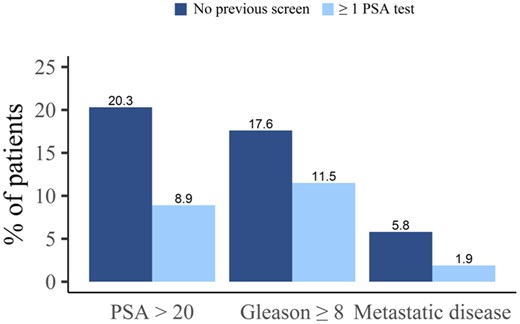
Evaluating Prostate-Specific Antigen Screening for Young African American Men with Cancer
AbstractBackground. Despite higher risks associated with prostate cancer, young African American men are poorly represented in prostate-specific antigen (PSA) t
/>
Conclusions: Among young African American men diagnosed with prostate cancer, PSA screening was associated with statistically significantly lower risk of PSA > 20, Gleason score ≥ 8, and metastatic disease at diagnosis and statistically significantly reduced risk of PCSM. However, the retrospective design limits precise estimation of...