



Stay on Track: a Pilot Randomized Control Trial on the Feasibility of a Diet and Exercise Intervention in Patients With Breast Cancer Receiving Radiation Therapy
Source : https://pubmed.ncbi.nlm.nih.gov/38530195/
Targeted lifestyle interventions during RT are feasible and could decrease cardiovascular comorbidities in patients with breast cancer. Larger-scale implementation with longer follow-up can better determine interventions that influence cardiometabolic health...
Targeted lifestyle interventions during radiotherapy are feasible and could decrease cardiovascular comorbidities in patients with breast cancer.
-
Albert Dekker2yrhard to do during but critical afterwards
The 10-year risk of developing a second primary breast cancer was ≈2% among women who did not carry a germline pathogenic variant compared with ≈9% among women who carried such a variant.
-
Albert Dekker2yrobviously testing for BRCA is important; what to do if negative is still not clear

Omitting Axillary Dissection in Breast Cancer with Sentinel-Node Metastases
Source : https://pubmed.ncbi.nlm.nih.gov/38598571/
The omission of completion axillary-lymph-node dissection was noninferior to the more extensive surgery in patients with clinically node-negative breast cancer who had sentinel-node macrometastases, most of whom received nodal radiation...
The estimated 5-year recurrence-free survival were 89.7% in the sentinel-node biopsy-only and 88.7% in the dissection groups, with a country-adjusted HR for recurrence or death of 0.89.
-
Albert Dekker2yrit is obviously important to take in consideration pretreatment number of LN and the overall risk of disease
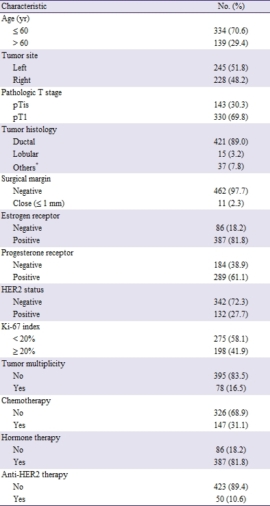
Hypofractionated Partial Breast Irradiation With Intensity-Modulated Radiotherapy in Early Breast Cancer or Carcinoma In Situ: an Investigational Short-Term Analysis
Source : https://ejbc.kr/DOIx.php?id=10.4048/jbc.2023.0296
Kang NK, et al. J Breast Cancer. 2024 Mar;27:e11. https://doi.org/10.4048/jbc.2023.0296
The 2-year disease-free and OS rates were 94.0% and 99.8%, respectively.

Clinical, Epidemiologic, and Pathologic Significance of ERBB2-Low Expression in Breast Cancer
Source : https://pubmed.ncbi.nlm.nih.gov/38517439/
These findings suggest that there were clinical, pathological, and epidemiological differences between ERBB2-low and ERBB2-negative BC, raising the possibility that ERBB2-low might be a unique biologic entity.
These findings suggest that there were clinical, pathological, and epidemiological differences between ERBB2-low and ERBB2-negative breast cancer, raising the possibility that ERBB2-low might be a unique biologic entity.